


Get answers to our most frequently asked questions.

  1. What is TAED?
  2. How is Polident Microclean Formula better than current or "old" Polident?
  3. What are the "other microorganisms" the new formula kills?
  4. Should I soak my dentures for 3 minutes or 5 minutes?
  5. Why should I use Polident Microclean instead of toothpaste? How is Polident with Microclean better than toothpaste?
  6. Which leading regular toothpastes were tested?
  7. Is there any difference in the effervescence (e.g. bubble quantity, bubbling force and etc.) of the Polident MicroClean formulas?
  8. Which US retailers carry Polident for Partials?
  9. Which US retailers carry Dentu Crème? Dentu Gel?
  10. Should I use 1 tablet per denture (upper, lower, or partial) or 1 tablet per all the dentures I have?
  11. What is the difference between brushing dentures and soaking dentures?
  12. Are Polident® Denture Cleansers available in different forms, strengths or flavors?
  13. How should Polident® tablets be used?
  14. Can any of the Polident® Denture Cleanser tablets be used overnight?
  15. Can partials be soaked in Polident® 3 Minute?
  16. What is Polident® Triple Mint?
  17. Why should I use specialty denture toothpaste?
  18. How do denture cleansers work?
  19. Why should I clean my dentures?
  20. Can denture cleansing tablets alone dislodge trapped food particles?
  21. How soon will it start to work?
  22. Can I use more or less Polident® tablets more than recommended?
  23. Why is it important to use Polident® MicroClean Formula every day?
  24. Can Polident® be used regularly/indefinitely?
  25. Will bleaching damage my dentures?
  26. Will household bleach damage my dentures?
  27. Can I use Polident® MicroClean to clean other oral appliances?
  28. How does Polident® 3 Minute MicroClean Formula work?
  29. What is Polident® Overnight Whitening used for?
  30. What is Polident® Partials MicroClean Formula used for?
  31. What is Polident® Smokers used for?
  32. How does Polident® Smokers work?
  33. Can I reuse the Polident® tablet solution several times?
  34. I currently brush my dentures with toothpaste. Should I replace my toothpaste with Polident® MicroClean Formula?
  35. How do you use Polident® Dentu-Crème?
  36. Even though the products do not contain fluoride, can Dentu-Crème be used on natural teeth?
  37. Do I have to remove my dentures when I use Polident® Dentu-Crème?
  38. Are dentures durable (against scratches and nicks)?
  39. Will brushing with regular toothpaste damage my dentures?
  40. I've noticed a slippery residue on my denture? How do I get it off?
  41. I've notice flecks in the new Polident MicroClean solution. Is that normal?

1. What is TAED?
TAED is an organic compound which activates the oxidizers in Polident MicroClean Formula to form peracetic acid. Peracetic acid provides antifungal and antibacterial action and has stronger antimicrobial action than active oxygen products alone (traditional tablets).
2. How is Polident Microclean Formula better than current or "old" Polident?
Polident's new MicroClean's formula is proven to not only kill 99.9% of odor-causing bacteria, but also kills more key microorganisms found on dentures than leading regular toothpastes.*
3. What are the "other microorganisms" the new formula kills?
Polident Microclean kills candida albicans which is a yeast that is sometimes found in the oral cavity of denture wearers.
4. Should I soak my dentures for 3 minutes or 5 minutes?
Polident MicroClean formula kills 99.9% of odor-causing bacteria in just 3 minutes and kills other microorganisms in 5 minutes, when used as directed.
5. Why should I use Polident Microclean instead of toothpaste? How is Polident with Microclean better than toothpaste?
Polident MicroClean's unique formula is proven to kill 99.9% of odor-causing bacteria. Plus more key microorganisms found on dentures than leading regular toothpastes.*

Family toothpastes contain abrasives to clean mainly through mechanical action and most do not contain antimicrobial ingredients. Polident is non abrasive.
6. Which leading regular toothpastes were tested?
Polident MicroClean was evaluated against Crest Cavity Protection and Colgate Cavity Protection for antibacterial and antifungal efficacy
7. Is there any difference in the effervescence (e.g. bubble quantity, bubbling force and etc.) of the Polident MicroClean formulas?
Effervescence should be similar; however, the foam head in Polident MicroClean may not last as long, this has no effect on cleaning ability.
8. Which US retailers carry Polident for Partials?
Walmart, Kmart, Kroger and some regional grocery and drug stores.
9. Which US retailers carry Dentu Crème? Dentu Gel?
Dentu Crème is available in most major stores. Dentu Gel has been discontinued in the United States, but limited quantities may be available at amazon.com or drugstore.com
10. Should I use 1 tablet per denture (upper, lower, or partial) or 1 tablet per all the dentures I have?
Use one tablet per the set of dentures (upper and lower) or per individual denture (upper, lower, or partial).
11. What is the difference between brushing dentures and soaking dentures?
Brushing dentures with a toothbrush and toothpaste will remove plaque and food particles stuck to it through mechanical action. Soaking dentures in a cleaning solution such as Polident® MicroClean Formula kills the germs that can cause denture odor and provides effective removal of odor-causing food particles and plaque in cracks and crevices that may not be accessible with a toothbrush. Therefore, brushing and soaking dentures every day is more effective than brushing alone.!
12. Are Polident® Denture Cleansers available in different forms, strengths or flavors?
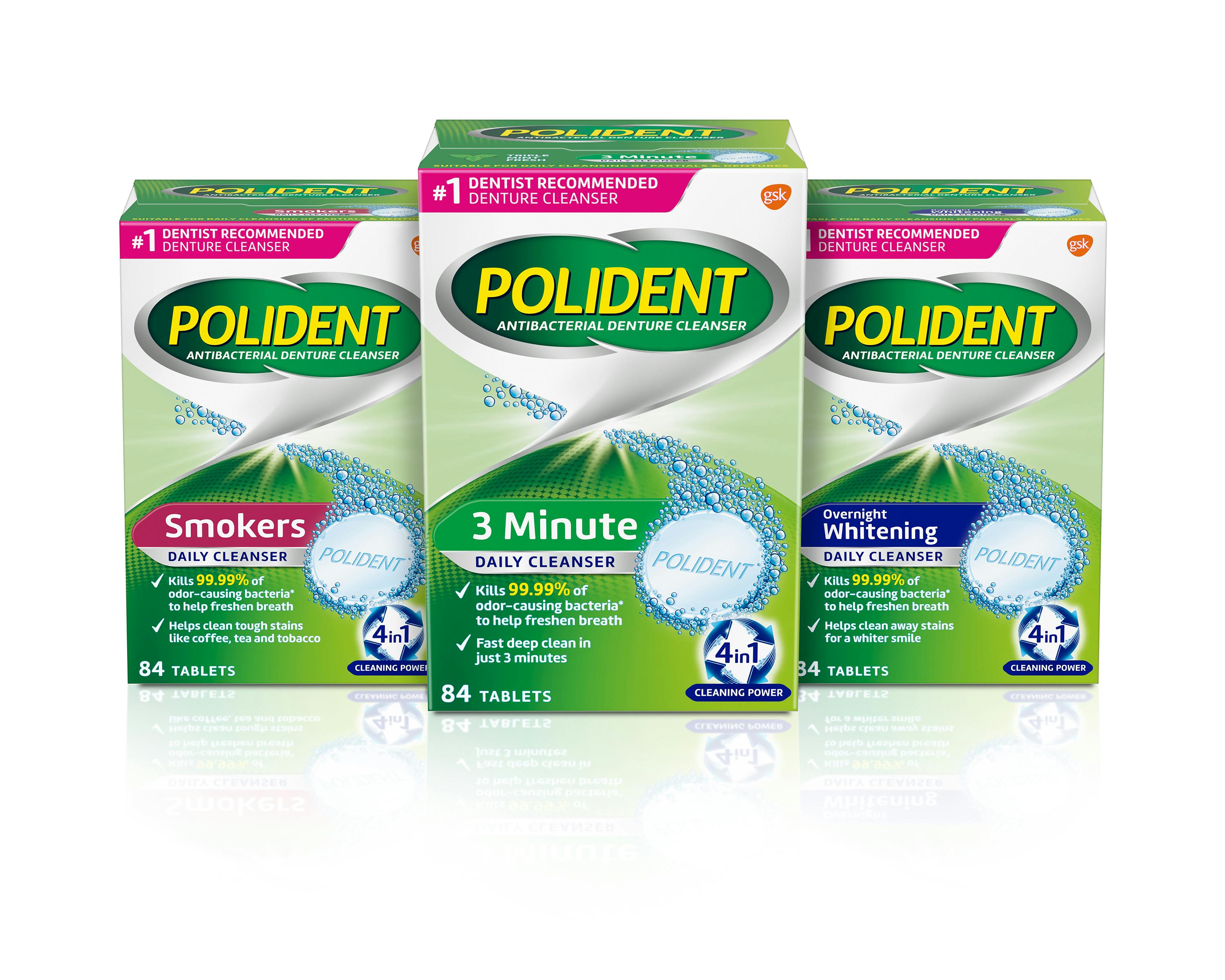
Yes, Polident® MicroClean Formula is available in four different formulations to meet your different needs - 3 Minute, Overnight Whitening, Smokers, and Partials. Choose the one that's right for you
13. How should Polident® tablets be used?
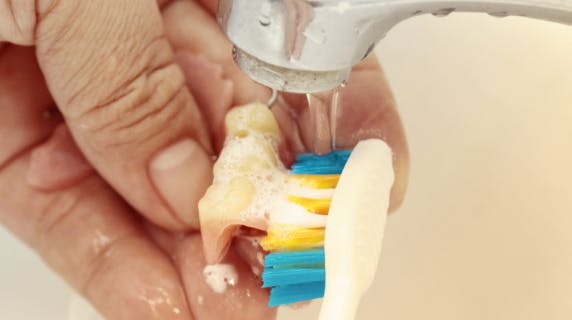
Drop one Polident® MicroClean tablet into enough very warm water to cover denture or partial. Soak in Polident® effervescing solution according to package directions (for example, Polident® 3 Minute cleans in a little as three minutes). After soaking, brush with Polident solution and rinse dentures with running water. For clean, fresh dentures, use Polident® at least once a day. Your denture or partial may be safely soaked in Polident® solution overnight.

CAUTION: Keep tablets in a cool, dry place; out of the reach of children and elderly needing care. Do not place tablets or solution in the mouth.
14. Can any of the Polident® Denture Cleanser tablets be used overnight?
Yes, it is safe to use any of the Polident® MicroClean formulas overnight.

The Academy of General Dentistry recommends removing dentures for eight hours every day; this gives your gums a chance to rest and promotes better gum health. This is a great opportunity to clean your dentures with Polident® MicroClean daily.
15. Can partials be soaked in Polident® 3 Minute?
Yes, you can soak partials and orthodontic retainers in Polident® 3 Minute denture cleanser, but we recommend to use Polident® for Partials.
16. What is Polident® Triple Mint?
Polident® Triple Mint is an enhanced flavoring system combining peppermint oil, spearmint oil and menthol to leave dentures clean and fresh
17. Why should I use specialty denture toothpaste?
The highly polished surface of a new denture or partial can be scratched by ordinary toothpastes allowing bacteria to collect and grow. Polident® Dentu-Crème is a specially formulated denture cleansing toothpaste with gentle cleaning agents that safely leave dentures fresh while they kill germs that cause denture odor. It is formulated to clean and freshen full or partial dentures outside of the mouth.
18. How do denture cleansers work?
Polident® MicroClean Formula contain a combination of bleaching agents, detergents and surfactants, all working together to help keep your dentures clean.
19. Why should I clean my dentures?
Cleaning your dentures every day is necessary for:
  • preventing bacterial plaque buildup that can cause odor and gum irritation
  • preventing daily stains
  • controlling denture odor
  • improving denture appearance
  • maintaining good oral health

Cleaning your denture with Polident, as part of a daily oral health routine, helps contribute to good oral health.

20. Can denture cleansing tablets alone dislodge trapped food particles?
Brushing and soaking are recommended for best results. Soaking your dentures in tablets may not fully remove food particles and plaque.
21. How soon will it start to work?
Cleaning begins as soon as the tablet starts to dissolve. Please follow soak time directions on the box for best results (Overnight = 8 hours, Smokers = 15 minutes, Partials = 5 minutes).
22. Can I use more or less Polident® tablets more than recommended?
No. Use Polident MicroClean Formula as directed.
23. Why is it important to use Polident® MicroClean Formula every day?
Once you place your denture in your mouth, plaque and bacteria begin to build up again. Polident MicroClean's unique formula is proven to kill 99.9% of odor-causing bacteria. Plus more key microorganisms found on dentures than leading regular toothpastes.

It is important to properly clean your dentures every day because brushing and soaking work together to give you the best results. We recommend soaking daily with Polident® tablets, brushing your dentures with the Polident® solution, and then rinsing under running water.

Cleaning your denture with Polident, as part of a daily oral health routine, helps contribute to good oral health.
24. Can Polident® be used regularly/indefinitely?
Polident® MicroClean Formula is recommended for daily use.
25. Will bleaching damage my dentures?
Polident® MicroClean Formula is designed to clean dentures and, if used as directed, is compatible with commonly used denture materials.
26. Will household bleach damage my dentures?
Household bleach is not recommended for cleaning dentures. Some studies have shown household bleach can cause discoloration of dentures.
27. Can I use Polident® MicroClean to clean other oral appliances?
Polident for Partials cleans metal partial surfaces and orthodontic retainers.

We have not evaluated the Polident® MicroClean formula as of yet for cleaning the following:
  • Toothbrushes
  • Mouth guards
  • Night guards
  • Soft-lining dentures
  • Dentures made from Valpast.
  • Invisalign braces
28. How does Polident® 3 Minute MicroClean Formula work?
Polident® 3 Minute MicroClean is specially formulated to dissolve quickly so that the cleaning and freshening agents can get to work right away.
  • Formula kills 99.9% of odor-causing bacteria
  • Bleaching agents help restore dentures to their original whiteness
  • Detergents help penetrate deposits and lift them away
  • Peppermint and spearmint oils and menthol leave your dentures feeling fresh
  • Formula kills other microorganisms when used for five minutes.
29. What is Polident® Overnight Whitening used for?
Polident® Overnight Whitening MicroClean Formula is specially formulated to clean full or partial dentures overnight. The Academy of General Dentistry recommends removing dentures for eight hours every day; this gives your gums a chance to rest and promotes better gum health. So this is a great opportunity to deep-clean your dentures with Polident® Overnight Whitening.
30. What is Polident® Partials MicroClean Formula used for?
Polident® Partials MicroClean Formula is suitable to effectively clean partials and orthodonitic retainers without corroding metal surfaces.
31. What is Polident® Smokers used for?
Polident® Smokers MicroClean Formula is specially formulated to clean tough tobacco stains from full dentures. Polident® Smokers also is proven to be effective at removing blueberry, coffee and tea stains.
32. How does Polident® Smokers work?
Polident® Smokers MicroClean Formula is specially formulated to remove tough food and tobacco stains and plaque in 15 minutes through a combination of detergents and bleaching agents. It contains a unique combination of peppermint and spearmint oils and menthol to leave your denture feeling fresh.

Don't be disappointed if you don't see as many immediate bubbles with Polident® Smokers. It is formulated to dissolve more slowly than Polident® 3 Minute or Polident® Partials
33. Can I reuse the Polident® tablet solution several times?
No. Use Polident® tablets as instructed.
34. I currently brush my dentures with toothpaste. Should I replace my toothpaste with Polident® MicroClean Formula?
Yes, and here's why. Dentures are softer than natural teeth. And because ordinary toothpaste is abrasive, it will scratch your dentures. These scratches give bacteria a place to attach and grow, and bacteria can cause bad breath.

Instead of ordinary toothpaste, soak daily with Polident® MicroClean Formula and brush afterwards with the Polident® solution. Polident MicroClean's unique formula is proven to kill 99.9% of odor-causing bacteria. Plus more key microorganisms found on dentures than leading regular toothpastes.* Cleaning your denture with Polident, as part of a daily oral health routine, helps contribute to good oral health.
35. How do you use Polident® Dentu-Crème?
For best results, follow package instructions.
36. Even though the products do not contain fluoride, can Dentu-Crème be used on natural teeth?
No. These products should not be used in the mouth.
37. Do I have to remove my dentures when I use Polident® Dentu-Crème?
Yes. These products are designed to clean dentures after they are removed from the mouth.
38. Are dentures durable (against scratches and nicks)?
Dentures are made of acrylic. The denture acrylic is much softer than your natural teeth, so:
  1. Do not use ordinary toothpaste on your dentures. Ordinary toothpaste often contains abrasives. These abrasives are ideal for cleaning your natural teeth but scratch dentures. These scratches become places where bacteria can attach and grow, and bacteria can lead to denture odor.
  2. Use a soft denture brush or soft toothbrush. Unlike toothpaste, Polident MicroClean is non-abrasive.
39. Will brushing with regular toothpaste damage my dentures?
Yes. Ordinary toothpaste contains abrasives. These abrasives are ideal for cleaning your natural teeth but can scratch dentures. These scratches become places where bacteria can attach and grow, and bacteria can lead to denture odor.

Use Polident® MicroClean Formula instead of ordinary toothpaste to brush your dentures. Polident MicroClean's unique formula is proven to kill 99.9% of odor-causing bacteria. Plus more key microorganisms found on dentures than leading regular toothpastes.* Cleaning your denture with Polident, as part of a daily oral health routine, helps contribute to good oral health.
40. I've noticed a slippery residue on my denture? How do I get it off?
If you notice residue on your denture after following the package instructions to brush with the Polident solution, you may need to rinse it off a few more times and wipe it off with a cloth.
41. I've notice flecks in the new Polident MicroClean solution. Is that normal?
After the Polident solution has fully dissolved, you may notice sediment at the bottom of the container. This is normal.

Remember to thoroughly rinse your denture with running water before placing the denture in your mouth.

*Colgate Cavity Protection and Crest Cavity Protection